


The hospitality industry is facing an unprecedented fraud crisis that most operators haven’t fully grasped, and neither have the hospitality tech platforms that serve them. Chargeback fraud alone continues to grow as the hospitality sector sustains part of the $20 billion affecting merchants globally in 2023, with businesses losing an estimated 2.5 times the original transaction amount for every successful chargeback. Meanwhile, the broader hospitality sector bleeds 5-6% of annual worldwide revenue to various forms of fraud.
Perhaps most alarming is the 704% surge in deepfake face-swap attacks on ID verification systems in 2023, signaling that fraudsters have moved far beyond simple fake IDs to sophisticated AI-powered deception. Today, criminals can generate hyper-realistic fake IDs for as little as $15. A recent survey found that 50% of businesses fell victim to at least one audio or video deepfake in 2024, while 58% of businesses globally still encounter fake or modified physical documents that bypass traditional verification methods.
Critical Reality Check: For hospitality leaders still relying on visual inspection and basic ID scanning, the message is clear: traditional verification methods are fundamentally inadequate against modern fraud techniques. The question isn’t whether your property will encounter sophisticated fake documents – it’s whether your verification systems will catch them.
The Evolution of Document Forgery: From Craft to AI-Powered Industry
The fake ID landscape has undergone a dramatic transformation that most hospitality operators haven’t fully recognized. What once required specialized equipment and considerable skill can now be accomplished by anyone with internet access and minimal investment. This technological leap represents more than just improved counterfeiting – it’s the industrialization of identity fraud.

The New Economics of Fraud
The progression from amateur laminated cards to professional-grade counterfeits reflects broader technological democratization. Underground markets now operate as fraud-as-a-service operations, creating a stark economic reality that has fundamentally altered the fraud landscape. Traditional sophisticated fakes that once cost $200-$500 can now be generated using AI for just $15, achieving quality levels nearly indistinguishable from legitimate documents. These aren’t simple visual replicas; they incorporate legitimate security features, proper substrates, and maintain cross-document consistency that can fool experienced personnel.
Digital Manipulation Reaches New Heights
Digital manipulation has evolved beyond basic photo editing to encompass sophisticated AI-driven fraud techniques. The 704% surge in deepfake face-swap attacks on verification systems demonstrates how AI-generated imagery now bypasses basic biometric verification. Additionally, the study reporting 50% of businesses having experienced fraud involving audio or video deepfakes, indicates that synthetic media attacks are becoming mainstream rather than experimental.
Synthetic identity schemes represent perhaps the most sophisticated evolution, combining real stolen data with fabricated information to create believable but non-existent identities. These operations use legitimate Social Security numbers with fabricated personal details, creating identities that can build credit histories and pass basic verification checks. Deep learning models trained on legitimate document databases enable fraudsters to replicate not just visual elements but also the underlying data structures and validation patterns.
Industry Alert: The hospitality industry presents an attractive target for these sophisticated operations. Unlike financial institutions with rigorous verification protocols, hotels and short-term rentals traditionally rely on quick visual checks – approaches that are laughably inadequate against modern forgeries.
Technical Authentication: The Losing Battle of Traditional Verification
Understanding why traditional verification methods fail reveals a fundamental mismatch between evolving fraud capabilities and stagnant authentication approaches.
While modern identity documents incorporate increasingly sophisticated security features designed to prevent counterfeiting, these advances are systematically undermined by verification systems, whether manual visual inspection or outdated digital tools focused on basic ID collection, that haven’t kept pace with criminal innovation.
The Security Feature Arms Race
Document issuers continue investing in advanced security elements – UV-reactive inks, specialized substrates, raised text, microprinting, holographic overlays, RFID chips, and machine-readable zones with built-in validation checksums. These features represent genuine technological achievements, creating multiple layers of authentication that should theoretically prevent forgery. However, this defensive strategy fundamentally misunderstands the modern fraud landscape.

The critical flaw lies in assuming that sophisticated security features provide protection when the verification methods examining them remain primitive. Modern fraud operations have industrialized access to professional-grade equipment and materials, enabling them to replicate even advanced security elements at scale. More importantly, they’ve recognized that they don’t need to perfectly replicate every security feature, they only need to fool the verification system that will examine their forgeries.
Where Traditional Verification Fails
Traditional verification methods, whether manual visual inspection, basic UV lights, simple digital scanners, or rudimentary online ID collection tools, cannot reliably detect sophisticated counterfeits that incorporate legitimate security features. These approaches provide false confidence while missing advanced forgeries designed specifically to bypass rudimentary checks. Even digital verification systems that capture and analyze machine-readable elements like barcodes and QR codes can be fooled by forgeries with valid format structures and checksum calculations that satisfy basic validation algorithms.
The verification gap becomes even more pronounced with online and digital verification processes. Basic ID collection tools that rely on simple image capture and template matching cannot detect sophisticated photo manipulation or synthetic document generation. While advanced security elements like RFID chips and cryptographic signatures exist, most hospitality verification systems, both physical and digital, cannot access or validate these components, rendering their security benefits meaningless. Cross-field consistency checks that could reveal sophisticated forgeries require advanced analysis capabilities that basic ID checking tools, whether deployed in-person or online, simply don’t possess.

The Technology Disparity
This creates a dangerous asymmetry: fraudsters invest in advanced counterfeiting capabilities while legitimate businesses rely on verification methods designed for an earlier generation of threats. High-resolution imaging with multispectral analysis, template comparison algorithms, and machine learning-based anomaly detection exist and can identify sophisticated fakes, but only when implemented through verification systems built with cybersecurity expertise.
The most sophisticated fraud operations understand this disparity and exploit it systematically. They test their forgeries against the verification methods they expect to encounter, refining their techniques until they consistently bypass visual inspection and basic digital scanning. Meanwhile, hospitality operations continue using verification approaches that were inadequate even before AI democratized advanced counterfeiting.
Technical Note: Real-time database cross-referencing, watchlist screening, and velocity checking across platforms can reveal systematic fraud operations, but these capabilities require verification systems designed with cybersecurity principles rather than basic document capture functionality.
The fundamental issue isn’t the sophistication of document security features, it’s the inadequacy of verification systems that fail to leverage these features effectively. Until hospitality tech platforms recognize that document authentication requires cybersecurity-grade technology rather than basic ID checking tools, even the most advanced security features will continue losing the arms race against industrialized fraud operations.
The Multi-Layered Verification Imperative
The fundamental flaw in traditional hospitality verification lies in single-point failure modes. Statistical analysis reveals a sobering reality: sophisticated fakes have a 15-25% false negative rate when subjected only to basic ID checks, meaning one in four advanced forgeries goes undetected.
Why Single-Point Verification Fails
Real-world vulnerability scenarios demonstrate these weaknesses consistently across the hospitality industry:
- Perfect replica driver’s licenses with valid format codes routinely bypass visual inspection, incorporating legitimate security features that fool both human reviewers and basic scanning systems.
- Altered genuine documents with photo substitution maintain all original security features while presenting false identities, making detection nearly impossible without advanced biometric matching.
- Synthetic identity documents combine real templates with fabricated personal data, creating believable but non-existent persons that can pass basic verification checks.
- Cross-jurisdictional exploitation takes advantage of staff unfamiliarity with out-of-state document formats, allowing fraudsters to systematically target properties with predictable verification gaps.
Comprehensive Authentication Framework
Effective verification requires a multi-layered approach that addresses each potential failure point through redundant security measures. The most robust systems implement three-factor authentication that verifies:
- “Something you have” (the document)
- “Something you are” (biometric characteristics), and
- “Something you do” (behavioral patterns)
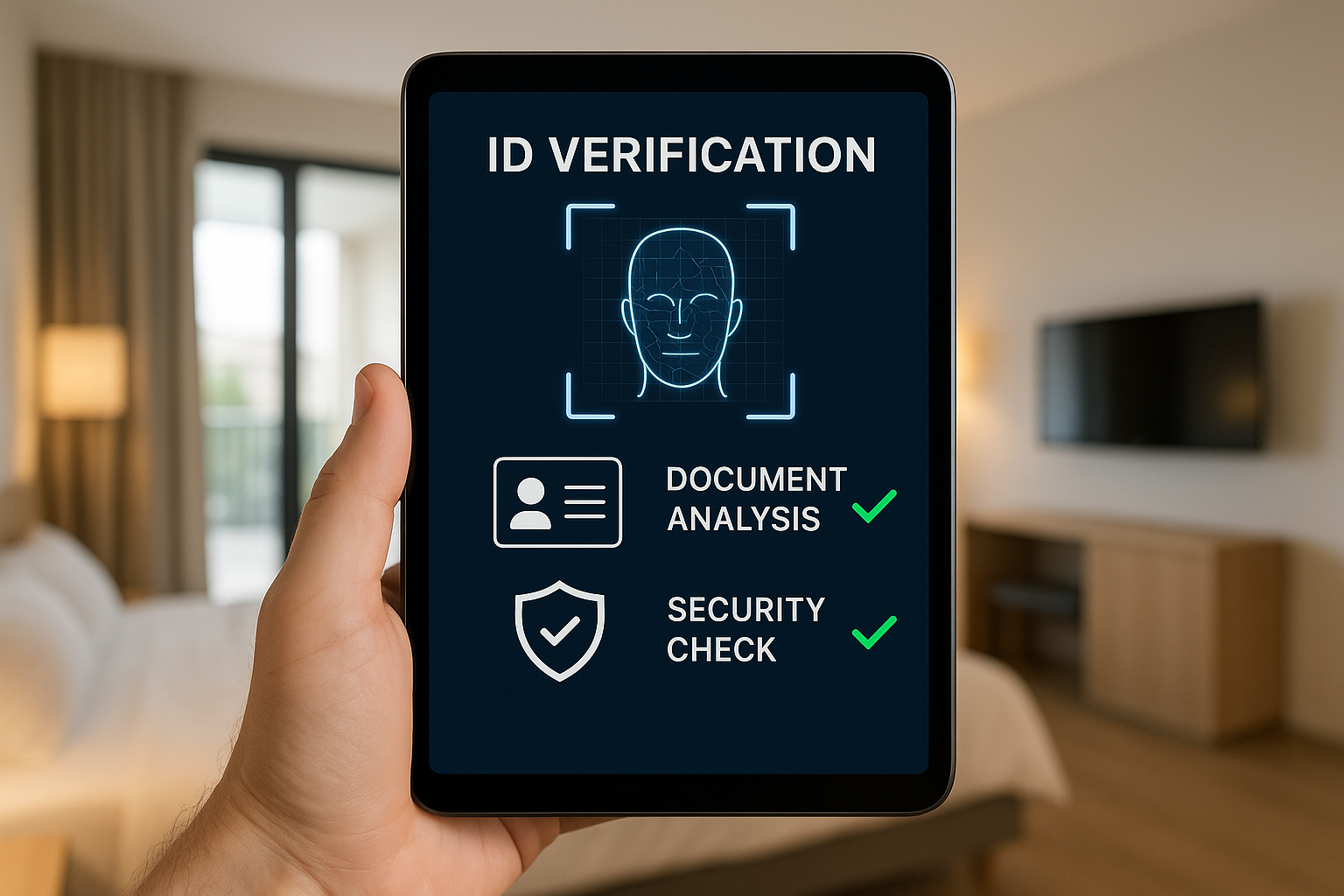
Document authenticity verification serves as the foundation layer, ensuring the presented credential is genuine through technical analysis of physical and digital security features combined with template matching against official document standards. Facial biometric matching with liveness detection confirms the person presenting the document is its legitimate owner and is physically present, defending against photo and video spoofing attempts that are increasingly common in sophisticated fraud operations.
Behavioral analysis provides the third verification layer by examining typing patterns, device fingerprinting, and geolocation data to identify suspicious activity patterns that may indicate fraud attempts. This layer is particularly effective against synthetic identity schemes that may pass document and biometric checks but reveal themselves through inconsistent behavioral patterns.
Key Takeaway: The key to successful implementation lies in real-time processing that maintains user experience quality. Modern systems can complete comprehensive verification in under five seconds, enabling a seamless guest journey through progressive verification that allows basic access while comprehensive checks complete in the background.
For an in-depth exploration of how AI-powered multilayer defense systems work together to create comprehensive protection against sophisticated fraud operations, see our detailed analysis in Fighting Fire with Fire: AI-Powered Multilayer Defense for Hospitality Platforms.
Future-Proofing Against Emerging Threats
The threat landscape continues evolving at an accelerating pace, driven by advancing AI capabilities and expanding access to sophisticated tools. Generative AI now creates entirely fabricated but realistic-looking documents, while deepfake technology generates photos matching specific demographic profiles with increasing accuracy. Automated document generation systems can produce thousands of unique fakes, and AI models are being cross-trained on security features to create increasingly convincing replicas.

Next-Generation Fraud Techniques
Looking beyond today’s fake ID challenges, synthetic identity fraud represents a glimpse into the future of sophisticated threats, projected to contribute $40 billion in global losses by 2027. These schemes combine real data from breaches with fabricated information to create identities that can build credit histories and pass basic verification checks over extended periods. The sophistication of these operations extends far beyond simple document forgery to encompass comprehensive identity construction that can fool traditional verification methods for months or years.
The fraud landscape of tomorrow presents even more complex challenges that transcend document authentication. Quantum computing poses potential threats to current cryptographic security methods, while IoT device exploitation creates new vectors for harvesting personal data. Social engineering attacks increasingly target verification system weaknesses, and even emerging blockchain-based identity systems present novel vulnerabilities that sophisticated fraudsters are already exploring.
Strategic Implementation Framework
Organizations must first navigate the critical distinction between comprehensive security and basic functionality. The difference between Identity Verification (IDV) and basic ID Collection (IDC) represents more than semantic variation – it reflects fundamentally different approaches to security. IDC solutions provide basic document scanning and data capture but offer false security against sophisticated fraud techniques. True IDV encompasses comprehensive verification including document authenticity, biometric matching, and behavioral analysis.
Vendor evaluation should prioritize cybersecurity expertise over basic functionality, focusing on several critical capabilities:
- Real-time adaptation to new fraud patterns and emerging threats
- Regulatory compliance with evolving requirements across jurisdictions
- Seamless integration with existing property management systems
- Guest experience quality that minimizes verification friction while maintaining security effectiveness
Equally important is recognizing that verification friction directly impacts conversion rates and guest satisfaction in ways that can undermine even the most sophisticated security measures. The goal isn’t perfect security, which is impossible, but rather creating verification systems that are significantly more difficult and expensive to defeat than alternative targets.
Building resilient verification architecture requires redundant verification pathways that prevent single points of failure, continuous monitoring with threat intelligence integration, and scalable infrastructure that maintains performance during peak booking periods. Data security and privacy protection must be embedded throughout the verification process, not added as an afterthought.
ROI Reality: Consider the financial impact: with merchants losing 2.5 times the original transaction amount for every successful chargeback and the hospitality sector losing 5-6% of annual revenue to fraud, advanced verification systems can deliver substantial returns through direct fraud prevention, reduced chargeback costs, regulatory compliance benefits, and operational efficiency gains.
The Verification Security Imperative
The hospitality industry stands at a critical inflection point where traditional approaches to guest verification are becoming not just inadequate but actively dangerous to business operations. Sophisticated document fraud requires equally sophisticated detection technology, and multi-layered verification is rapidly becoming table stakes rather than competitive advantage. For hospitality tech, this represents both a responsibility and an opportunity to equip operators with the sophisticated tools necessary to combat modern fraud.
The reality is that property managers and hotel operators cannot be expected to become fraud detection specialists while running their businesses. Staff training alone cannot keep pace with AI-powered fraud techniques, and regulatory compliance increasingly demands technical verification capabilities that manual processes simply cannot provide. The financial and reputational costs of fraud continue escalating beyond what most hospitality operations can absorb, making robust verification tools a business necessity rather than a luxury.
Technology platforms have a critical role in bridging this expertise gap by embedding cybersecurity-grade verification capabilities directly into their solutions. The path forward requires vendor evaluation of technical capability frameworks that prioritize security effectiveness while maintaining the seamless user experience that hospitality operations demand.
The choice facing hospitality leaders is stark but clear: evolve verification capabilities to match the sophistication of modern threats, or accept the inevitable consequences of being outpaced by criminals who have already embraced the future of fraud.
