


Leading Hospitality tech platforms are transforming their guest verification experience, achieving > 95% completion rates while reducing fraud by 90%
Picture this: Sarah books a weekend getaway at a boutique Vacation Rental she’s been eyeing for months. She’s excited, already planning her itinerary, and then she hits the verification process. She’s suddenly faced with a confusing maze of document uploads, unclear instructions, and a interface that feels more like applying for a mortgage than checking into her dream vacation.
This scenario plays out thousands of times daily across the hospitality industry. Traditional security verification, not to mention manual screening practices, creates a fundamental tension: PMCs need protection from fraud and liability, but guests want seamless, welcoming experiences. Industry data shows that poorly designed verification flows can see abandonment rates exceeding 30%, directly impacting revenue and guest satisfaction.
But here’s what successful Hospitality tech platforms have discovered: the secret isn’t choosing between security and guest experience – it’s engineering systems that make verification feel like a premium service rather than a necessary evil.
The Psychology of Guest Verification Acceptance
Understanding guest psychology is the foundation of effective verification design. When guests encounter security measures, they’re making split-second judgments about trust, legitimacy, and whether the process respects their time and privacy.
The language you use shapes everything. Instead of “We need to verify your identity for security purposes,” leading Platforms say “Let’s get you checked in quickly and securely.” This subtle shift transforms verification from a barrier into a service. Premium Hospitality brands have mastered this art – they position verification as part of their VIP experience, similar to how luxury hotels frame concierge services.
Timing psychology matters. Guests are most receptive to verification requests immediately after booking, when excitement and commitment are highest. Wait too long, and verification feels like an unexpected hurdle. Present it too early in the booking flow, and it can kill conversions. The sweet spot? Within 24 hours of booking confirmation, framed as the next step in their journey.
The key is to understand that guest psychology, not just security requirements, drives verification success, transforming it from a suspicious interrogation into a welcomed step in the hospitality journey.
Engineering High-Completion Verification Flows
Achieving over 95% completion rates isn’t magic – it’s methodical design based on proven UX principles adapted for hospitality’s unique context.
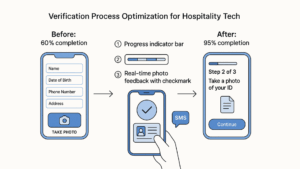
Progressive disclosure is your secret weapon. When multiple verification steps are needed, avoid overwhelming guests with exhaustive upfront requirements. Instead, reveal information needs gradually. Start with basic details, then progressively request additional information as guests move through the flow. This approach reduces cognitive load and prevents abandonment at the first step.
Mobile-first design isn’t optional, it’s essential. 2024 statistics indicate that 55%-70% of Vacation Rental bookings now happen on mobile devices, yet many verification flows are still designed for desktop. Mobile-optimized verification means large, thumb-friendly buttons, minimal typing requirements, and camera-based document capture that actually works in various lighting conditions.
Real-time feedback prevents frustration. The moment a guest uploads a blurry photo or enters information in the wrong format, your system should provide immediate, helpful guidance. “Photo looks a bit blurry, try holding your phone steady and ensuring good lighting” is infinitely better than a generic error message after submission.
A/B testing reveals counterintuitive insights. Many might assume shorter forms perform better, but testing often shows that well-explained longer forms can outperform confusing shorter ones. Guests prefer understanding why information is needed over being kept in the dark about requirements.
All-in-one platforms can expect to increase completion rates from ~60% to ~95% by implementing three simple changes:
- Adding a progress indicator
- Providing real-time photo quality feedback
- Sending encouraging SMS updates and reminders throughout the process.
These aren’t major technical overhauls, they are thoughtful UX improvements that acknowledge guest psychology.
Communication Strategies That Build Trust
The most successful verification programs reframe security as a benefit guests receive, not a hurdle they must overcome. This communication strategy transforms the entire experience.

Position verification as protection FOR guests, not FROM them. Instead of “We need to verify you’re not a fraudster,” try “We verify all guests to ensure your identity hasn’t been compromised” This subtle reframing makes guests feel protected rather than suspected.
Transparency builds trust faster than any security badge. Explain exactly what information you collect, how it’s protected, and why it’s necessary. “We use high-level encryption to protect your data and only share necessary details to ensure a smooth check-in” creates confidence rather than concern.
Proactive communication prevents anxiety. Ensure your Platform allows users to send guests a brief email or SMS before they encounter verification, explaining what to expect and why it matters. Suggest they include estimated completion time (and be realistic – if it takes 5 minutes, say 5 minutes, not 2) and what they’ll need handy.
Leading PMCs demand a top level verification process as they have discovered that guests who understand the verification process are 40% more likely to complete it successfully and report higher satisfaction scores. The key is making guests feel informed and in control rather than confused and coerced.
Measuring Success Beyond Completion Rates
While completion rates are important, they’re just one piece of the verification success puzzle. The most sophisticated Hospitality tech platforms track holistic metrics that capture the full impact of their verification programs.

Guest satisfaction scores post-verification reveal whether your process enhances or detracts from the overall experience. Leading platforms consistently see satisfaction scores above 4.5/5 for well-designed verification flows – proof that security and positive experience can coexist.
Support ticket reduction is a powerful success indicator. When verification processes are clear and intuitive, support requests drop dramatically.
Revenue protection metrics matter too, but they should be balanced against guest experience indicators. The goal isn’t maximum security at any cost – it’s optimal security that maintains trust and satisfaction while protecting against genuine threats.
The Future of Hospitality Verification

The Hospitality industry is evolving toward verification systems that are invisible to legitimate guests while being impenetrable to bad actors. This isn’t a distant future, it’s happening now among forward-thinking platforms that understand verification as a competitive advantage rather than a necessary evil.
The next frontier involves not only reliance on guest input, but also seamless verifications that run entirely behind the scenes. While guests complete simple, intuitive flows, sophisticated AI systems analyze behavioral patterns, device fingerprinting, and dozens of other risk signals that don’t require any guest input. Advanced document verification powered by machine learning can detect sophisticated forgeries in milliseconds, while behavioral analysis identifies suspicious booking patterns before they become problems. (Learn more about these advanced security layers in our “AI-Powered Defense for Hospitality Platforms” article.)
The most successful Hospitality tech companies are discovering that excellent verification doesn’t just prevent problems, it creates opportunities. PMCs using robust, guest-friendly verification can command premium rates, attract quality guests, and build stronger brand trust.
For Hospitality tech platforms, offering verification excellence isn’t just about security, it’s about providing a truly complete solution and enabling your clients to deliver the seamless, trustworthy experiences that drive bookings, reviews, and repeat business. In an industry where guest experience is everything, making security feel like hospitality isn’t just smart, it’s essential.
The platforms that master this balance won’t just protect their clients from fraud, they’ll help them thrive in an increasingly competitive market where trust, security, and exceptional experience are no longer optional, but fundamental to success.
