


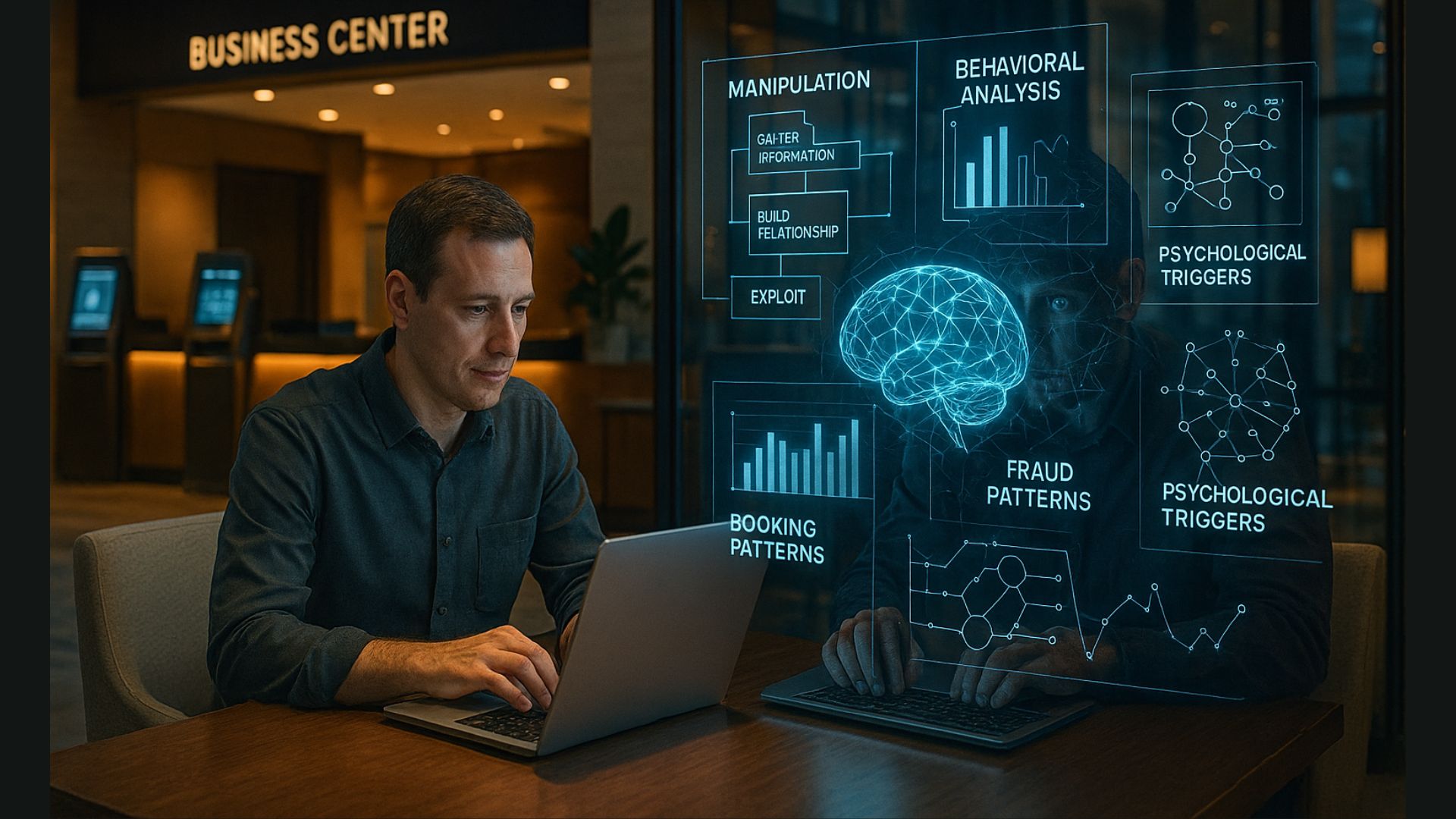
From the Fraud Triangle to AI-enhanced manipulation, discover the psychological drivers behind hospitality fraud and how criminal minds exploit human nature to steal billions from the industry.
Every year, hotels lose 5-6% of their annual revenue to fraud – that’s over half a billion dollars vanishing from an industry built on trust and service. Behind these staggering numbers lies a sobering truth: while most fraud prevention focuses on technology and processes, we cannot neglect the psychological battlefield.
Fraudsters don’t just exploit system vulnerabilities; they manipulate human nature itself, turning our industry’s greatest strength – exceptional guest service – into our most dangerous weakness. This analysis reveals the psychological frameworks driving hospitality fraud, from the classic “Fraud Triangle” to emerging AI-enhanced manipulation tactics. You’ll discover how criminal minds operate and why understanding fraud psychology is crucial for any hospitality professional.
Decoding the Fraud Triangle: What Drives Hospitality Criminals
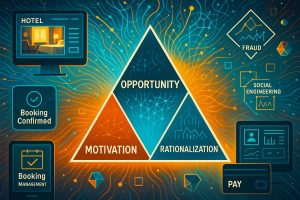
Hospitality fraud isn’t random – it follows predictable psychological patterns rooted in human motivation and opportunity. The Fraud Triangle, developed by criminologist Donald R. Cressey through his groundbreaking criminological study of convicted fraudsters in the 1940s, reveals that three psychological elements must align for fraud to occur: Motivation/Pressure, Perceived Opportunity, and Rationalization.
- Motivation often stems from financial pressure that feels insurmountable – gambling debts, medical bills, or simply the allure of easy money in a cash-rich industry. Fraudsters are drawn to hospitality because it represents accessible wealth with relatively low barriers to entry compared to other financial crimes. The industry’s reputation for handling large cash transactions, processing numerous credit card payments, and managing valuable guest data creates a psychological perception that “the money is there for the taking” for those willing to exploit the system.
- Perceived Opportunity thrives in hospitality’s cash-heavy, guest-focused environment where security protocols often take a backseat to customer satisfaction. The industry’s decentralized operations, high employee turnover, and emphasis on quick service create numerous touchpoints where money or data can be diverted without immediate detection. Observant employees notice these gaps, from unsupervised cash registers during busy periods to booking systems with weak oversight, and file them away as potential solutions to future problems.
- Rationalization allows fraudsters to justify their actions with thoughts like “The hotel can afford it” or “These guests are wealthy anyway.” Criminals often view hospitality businesses as faceless corporations with deep pockets, making theft feel victimless. They rationalize their crimes by focusing on the industry’s perceived wealth – luxury hotels, expensive room rates, and affluent travelers, convincing themselves that their actions won’t meaningfully impact such “rich” targets. This psychological distancing helps fraudsters maintain their self-image while committing increasingly serious crimes.
Beyond situational factors, hospitality fraudsters often exhibit specific psychological traits: narcissism (inflated self-importance), greed (insatiable desire for more), and lack of empathy (disregarding impact on others). These aren’t pathological conditions, but personality characteristics that, when combined with opportunity and pressure, create a dangerous combination.
💭 Criminal Mindset: Fraudsters never see themselves as criminals. Research shows they consistently rationalize their actions as “temporary borrowing,” “evening the score,” or “taking what’s owed” – psychological self-deception that enables increasingly serious crimes.
Behavioral Patterns That Betray Criminal Intent
Fraudsters follow predictable behavioral patterns driven by their psychological makeup and criminal objectives. The psychology of deception creates consistent behavioral tells that repeat across cases, industries, and decades.
Identity fraud scammers exhibit consistent behavioral patterns when targeting hospitality operators, particularly their use of artificial urgency and scarcity to try and bypass verification processes. They create time pressure by claiming they need immediate booking confirmation for “urgent travel” or “last-minute business trips,” while suggesting scarcity through stories about being “unable to find availability anywhere else.” This behavioral pattern reveals their psychological strategy: exploiting operators’ revenue anxiety to rush through verification processes that might expose their fake documentation.
Payment fraud criminals display predictable behavioral signatures when combining fake personas with pressure tactics. They systematically create elaborate stolen or synthetic identities complete with fabricated references, then follow a consistent script of urgency claims like “I need to book tonight or I’ll lose this corporate rate” or “My company requires immediate confirmation for reimbursement.” This behavioral pattern betrays their criminal psychology as they understand that business owners facing financial stress will overlook documentation red flags when presented with seemingly legitimate bookings that promise quick revenue.
Platform evasion represents another reliable behavioral indicator. Fraudsters insist on moving communication off secure platforms like Airbnb or Booking.com, deliberately removing the psychological comfort that keeps victims cautious. This isn’t just about avoiding fees, it’s calculated psychology to eliminate safety nets.
Threshold avoidance tactics follow different patterns, particularly “order splitting” in procurement – dividing large purchases into smaller orders to avoid management review thresholds. This demonstrates criminal intelligence and psychological calculation, exploiting managers’ reliance on automated systems and exception reporting.
⚠️ Critical Warning: When someone insists on bypassing established security protocols, they’re removing the psychological and financial safety nets that protect victims from fraud.

How Social Engineering Turns Service Excellence Into Vulnerability
Hospitality’s “guest service mindset” creates unique psychological vulnerabilities that sophisticated fraudsters systematically exploit. The most successful hospitality fraudsters are essentially amateur psychologists who understand human nature with dangerous precision.
The Authority and Reciprocity Trap
Social engineering attacks leverage our psychological tendency to defer to authority figures. A fraudster might call claiming to be “corporate” needing urgent booking system access for an “emergency audit.” They use corporate terminology, demonstrate process knowledge, and create urgency that bypasses normal verification.
Pretexting, the act of creating fabricated scenarios with false identities, has doubled in accommodation and food services, now accounting for 20% of social engineering incidents. This reflects how effectively criminals exploit service-oriented psychology.
Fraudsters also understand reciprocity – when someone helps us, we feel obligated to return the favor. They might start by offering to “prepay” for extended stays or provide “additional security deposits” to appear trustworthy, establishing themselves as reliable guests before requesting special accommodations like bypassing standard ID verification or accepting alternative payment methods. This psychological manipulation makes hospitality operators feel indebted to accommodate these seemingly generous guests, not realizing they’re being set up to accept the very fake payments and stolen identities the fraudsters plan to use.
The Trust Transfer Technique
Another deceptive and sophisticated manipulation involves impersonating trusted business partners. Phishing attacks impersonating Booking.com exploit established trust relationships, leveraging authority (official emails), urgency (account suspension threats), and social proof (references to other hotels’ experiences).
These attacks trigger hospitality professionals’ deepest fears about reputation and revenue loss. Under emotional stress, even experienced professionals bypass normal skepticism.
🧠 Psychology Insight: Human elements factor into 68% of all data breaches, according to Verizon’s 2024 report, demonstrating that criminal success sometimes depends more on psychological manipulation than technical sophistication.
The AI Revolution: Making Criminal Psychology More Accessible
Artificial intelligence is democratizing sophisticated psychological manipulation, making advanced fraud tactics accessible to less skilled criminals while amplifying expert fraudsters’ effectiveness.
Historically, sophisticated manipulation required years of experience or natural talent. AI has shattered these barriers. Today, relatively unsophisticated criminals can use AI tools to craft psychologically compelling communications, generate convincing fake identities, and simulate trusted business partners’ communication patterns.
This creates a psychological arms race. As AI enables more criminals to execute sophisticated tactics, the baseline level of criminal competence rises across the entire fraud ecosystem. Traditional “gut instinct” detection methods become obsolete when AI can perfectly replicate the communication patterns and contextual knowledge humans use to assess authenticity.
The fundamental psychology of fraud remains constant as criminals still exploit motivation, opportunity, and rationalization. However, AI amplifies each element: it increases perceived opportunities, provides new rationalization (“everyone’s doing it”), and creates additional motivations through easier access to criminal tools.
🔮 Future Insight: As AI eliminates traditional red flags, new psychological verification methods become necessary. The challenge isn’t just technical, it’s maintaining appropriate skepticism without becoming paralyzed by suspicion.
When Psychology Becomes Weaponized
The criminal mind in hospitality fraud operates with disturbing consistency across different schemes and technologies. What emerges from this analysis is a clear picture: fraudsters aren’t just opportunistic criminals, they’re behavioral scientists who have reverse-engineered human nature to their advantage. The most unsettling revelation is how our industry’s greatest strengths become our most exploitable weaknesses, with the same helpfulness that creates memorable guest experiences making staff vulnerable to sophisticated manipulation.
This psychological arms race is accelerating as AI democratizes advanced manipulation techniques that once required years to master. The result is a landscape where traditional “gut instinct” detection methods are becoming dangerously obsolete, yet understanding these psychological patterns provides the foundation for building more effective defenses.
The next frontier lies in matching criminals’ psychological sophistication with equally advanced defensive strategies. While human psychology will always be a battlefield, the organizations winning this war are deploying AI-powered systems that can objectively screen threats without relying on vulnerable human judgment alone. Fighting Fire with Fire: AI-Powered Multilayer Defense for Hospitality Platforms explores how these advanced systems are turning the psychological tables on fraudsters.
