


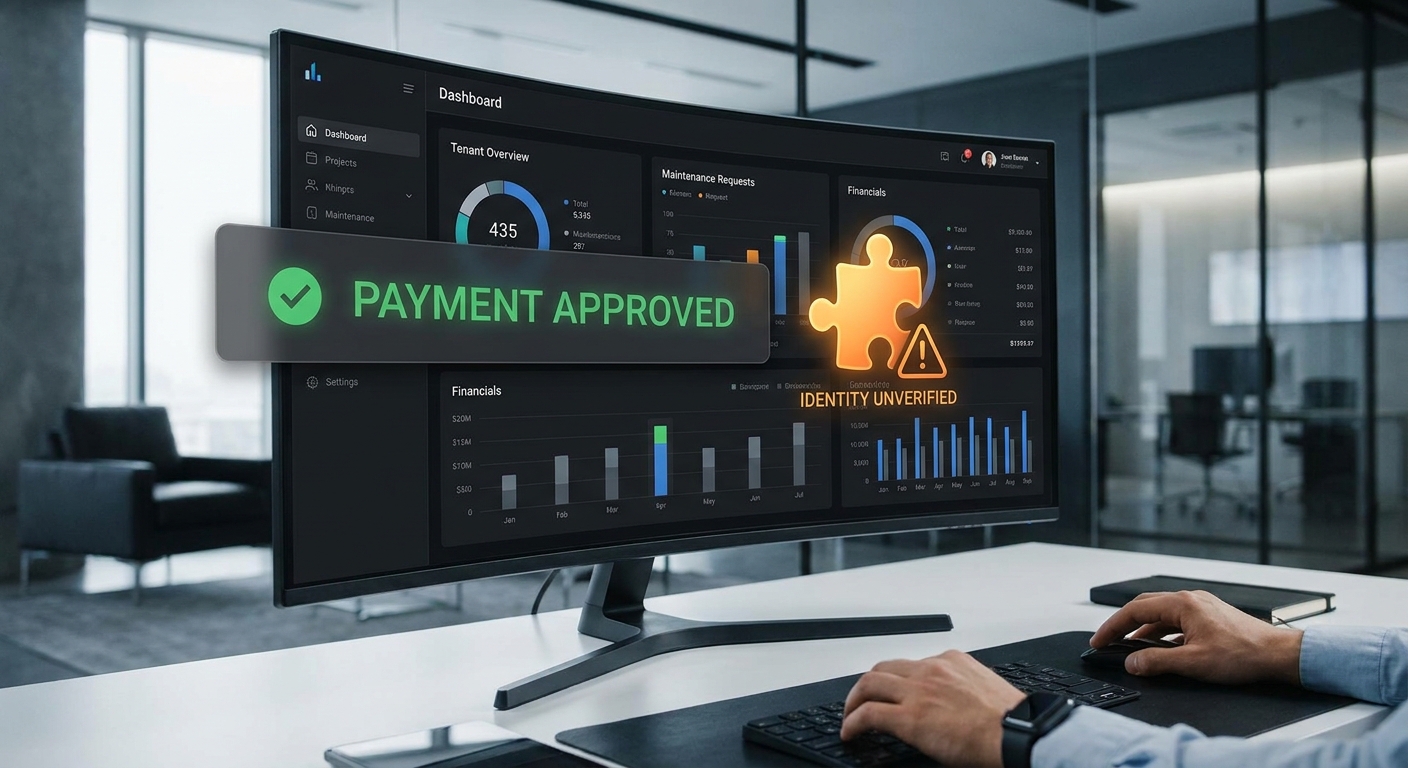
The notification pings. A new direct booking just landed. The dates are locked in, the revenue is secured, and most importantly, the payment processor – whether it’s Stripe, Adyen, or another gateway – has given the green light. The transaction is approved.
For many property management companies (PMCs) and short-term rental operators, that green checkmark triggers a familiar sigh of relief. The money is in the bank, so the guest must be legitimate.
Unfortunately, this assumption is one of the most dangerous blind spots in the hospitality industry today.
Relying on a payment gateway as your primary line of defense creates a false sense of security. Payment processors are incredibly sophisticated at doing exactly what they were built to do: verifying the validity of a card and the availability of funds. But they are not designed to verify the identity or the intent of the person typing in those numbers.
When operators confuse transaction authorization with identity authentication, they leave their properties, their owners, and their businesses exposed to risks that a payment gateway simply cannot stop.
What Your Payment Processor is Actually Checking (And What It Isn’t)
To understand the vulnerability, we have to demystify what happens during those few seconds between a guest clicking “Book Now” and the payment being approved.
When a payment gateway processes a transaction, it runs a series of checks to ensure the financial mechanics are sound. It looks at:
- Card Validity: Is the card active and not reported lost or stolen to the issuing bank?
- Available Funds: Does the account have sufficient credit or cash to cover the transaction amount?
- Address Verification System (AVS): Does the billing address entered match the address on file with the bank?
- Card Verification Value (CVV): Does the three- or four-digit code match the physical card?
- 3D Secure (3DS): If enabled, does the user pass the bank’s additional authentication step, such as an SMS code?
If these elements align, the payment is approved. But notice what is missing from that list.
The payment processor does not check if the person making the booking is actually the person named on the card. It does not check if the guest is using a synthetic identity or a purchased profile from the dark web. It certainly cannot tell you if the guest has a history of trashing rental properties, if they intend to throw an unauthorized party, or if they are booking on behalf of someone else.
The “Perceived Security” Trap Because money successfully changes hands, operators are lulled into a state of perceived security. They assume that because the financial hurdle was cleared, the operational risk is mitigated. This psychological trap causes PMCs to drop their guard, bypassing the necessary friction required to keep bad actors out of their properties.
The “Risk Window”: E-commerce vs. Hospitality
Part of the reason this misconception persists is that we are conditioned by standard e-commerce. If you buy a pair of shoes online with a stolen credit card, the transaction is approved, the shoes ship immediately, and the fraud is complete. Payment and fulfillment happen almost simultaneously.
Hospitality is entirely different. In the short-term rental space, there is a massive “Risk Window” – the days, weeks, or even months between the payment clearing and the guest actually checking into the physical property.
The Hospitality Risk Window While e-commerce fulfills orders instantly, hospitality deals in days or weeks between payment and check-in. Fraudsters exploit this exact time gap, knowing operators often stop looking closely once the payment clears. The payment gateway secured the funds, but it did nothing to secure the physical asset during this critical window.
Fraudsters specifically exploit this time gap. They know that a successful payment authorization will often cause a PMC to stop looking closely at the reservation. By the time the guest arrives at the property, the operator assumes the risk has already been managed. In reality, the payment gateway only secured the funds; it did absolutely nothing to secure the physical asset during that critical Risk Window.
The Three Threats a Verified Payment Cannot Stop
When you stop at payment verification, you leave the door open to three distinct categories of risk that cost the industry heavily in property damage, operational burnout, and lost revenue.
Sophisticated Fraud and Stolen Data Fraudsters rarely operate by simply stealing a physical credit card anymore. Today’s bad actors purchase “fullz” – complete identity profiles available on the dark web that include a person’s name, address, credit card number, CVV, and even social security number.
When a fraudster uses a “fullz” profile to book a stay, the AVS and CVV checks will pass perfectly. The payment gateway will approve the charge because the data matches the bank’s records. The transaction is valid, but the guest is a criminal. Without a separate layer of identity verification to confirm that the person checking in matches the identity used to book, the operator is completely blind to the fraud until the real cardholder issues a chargeback weeks later.
Intent and Behavioral Risk A perfectly legitimate, wealthy cardholder using their own credit card can still be a nightmare guest.
Money Doesn’t Equal Intent A perfectly legitimate, wealthy cardholder using their own credit card can still be a nightmare guest. Financial solvency is not an indicator of behavioral reliability. Protecting your physical asset requires analyzing booking behavior, not just bank balances.
Payment gateways cannot screen for intent. A verified payment does not prevent a guest from bringing unauthorized pets, throwing a massive party, causing thousands of dollars in property damage, or conducting illegal activities on the premises. Financial solvency is not an indicator of behavioral reliability. Protecting your physical asset requires analyzing booking behavior, not just bank balances.
The “Friendly Fraud” Loophole First-party misuse, commonly known as “friendly fraud,” occurs when a legitimate cardholder makes a booking, completes the stay, and then initiates a chargeback claiming they didn’t authorize the transaction or that the service was unacceptable.
This is a massive and growing problem. According to Chargeback Statistics 2026 data, the average chargeback value for travel and hospitality is $120, which is the highest across all industries. Furthermore, industry reports indicate that friendly fraud accounts for roughly 75% of all chargeback cases. Standard payment verification offers zero protection against friendly fraud because the initial transaction was entirely legitimate.
Deep Dive: The Anatomy of a Lost Chargeback
Why do PMCs lose so many of these friendly fraud disputes, even when the payment was verified by Stripe? It comes down to the burden of proof.
When a cardholder initiates a chargeback, the credit card networks (like Visa and Mastercard) require the merchant to provide “compelling evidence” to reverse it. A receipt from your payment gateway proving the card was charged is not compelling evidence. It only proves a transaction occurred, not who authorized it or who consumed the service.
To win a dispute, you must prove that the cardholder actively participated in the transaction and benefited from the stay. If your only defense is a Stripe authorization code, the bank will almost always side with the cardholder. Winning requires a comprehensive digital paper trail: a verified government ID matching the credit card, a digitally signed rental agreement capturing the device’s IP address, and documented communication.
The Burden of Proof Payment processors secure the authorization, but you are responsible for securing the evidence. If you cannot definitively prove the person who paid is the person who stayed, you will lose the chargeback, the revenue, and the operational time spent fighting it.
What True Identity Authentication Actually Looks Like
If payment gateways check CVVs and billing addresses, what does actual identity authentication check? True verification goes far beyond asking a guest to upload a selfie. It involves analyzing dozens of invisible data points to build a comprehensive risk profile.
Device fingerprinting analyzes the hardware being used to make the booking. Is it a known device, or is it running software designed to mask its location? IP distance analysis calculates the physical distance between the IP address making the booking, the billing address on the credit card, and the location of the rental property. Massive discrepancies often indicate fraud.
Biometric liveness checks ensure that the person uploading an ID is a live human being present in that exact moment, not a fraudster uploading a stolen photograph or an AI-generated deepfake. Behavioral velocity tracks how quickly and frequently a user is attempting to book across the internet, flagging bot-like behavior or rapid-fire fraud attempts.
None of these critical checks happen inside a standard payment gateway.
The Chain of Responsibility: Why Tech Platforms Must Evolve
The responsibility to fix this misconception does not fall solely on the shoulders of property managers. It extends up the chain to the hospitality tech platforms – the PMS providers, channel managers, and direct booking engines that power the industry.
We are in the midst of a direct booking revolution, which is incredibly positive for operator margins. However, when a tech platform offers a “complete direct booking engine” that includes a Stripe integration but lacks embedded guest screening, they are handing their users an incomplete and dangerous tool.
The Direct Booking Danger When a tech platform offers a “complete” direct booking engine that includes a payment integration but lacks embedded guest screening, they are handing their users an incomplete and dangerous tool. Payment processing without identity verification is a liability, not a complete solution.
Tech platforms have a responsibility to educate their users that integrating a payment gateway is only step one. When platforms fail to provide native, robust screening solutions, their users inevitably suffer from fraud, property damage, and chargebacks. This leads to operator burnout and, ultimately, platform churn. By embedding comprehensive screening alongside payment processing, tech platforms create a stickier, safer product that protects the entire ecosystem.
The Complete Trust and Safety Stack
The solution is not to abandon payment gateways. They are a critical, non-negotiable component of modern commerce. The solution is to recognize their limitations and build a complete trust and safety stack.
Payment verification and guest screening are two halves of the same security coin. They must work in tandem to protect the business holistically. Payment verification protects your money at the point of transaction. Identity and intent verification protects your property, your owners, and your reputation before the point of access.
A verified payment is the starting line of a secure booking, not the finish line.
By integrating intelligent screening – which analyzes behavioral risk, verifies physical IDs against global watchlists, and flags suspicious patterns – operators can close the gap that payment processors leave open. Autohost provides this essential missing layer, working seamlessly alongside your payment gateway to ensure that the person who paid for the booking is exactly who they say they are, and that they intend to treat your property with respect.
