


When a direct booking comes through your property management system and the payment is successfully captured, it is easy to feel a sense of relief. The payment gateway displays a reassuring green checkmark, signaling that the transaction is secure and the funds are on their way. For many operators and PMCs, this green checkmark is treated as the ultimate green light for the reservation itself.
But what exactly is happening behind the scenes of that approval?
A verified payment proves that a credit card is active. It does not prove that your property is safe.
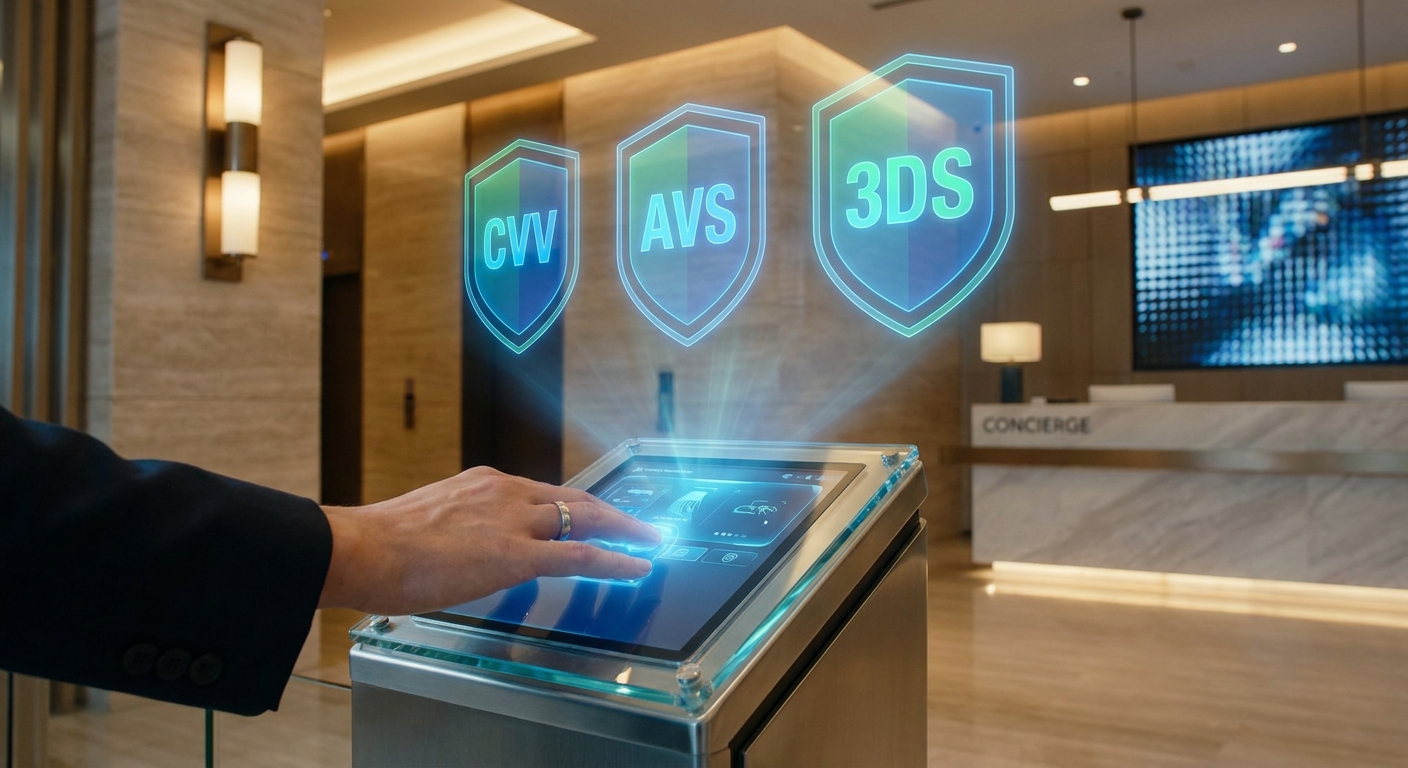
To understand the true security of a direct booking, we have to look under the hood of modern payment processing. Payment gateways rely on a specific alphabet soup of security protocols – primarily CVV, AVS, and 3DS – to validate transactions. While these tools are highly effective at what they were built to do, they have a massive blind spot when it comes to the unique risks of the hospitality industry.
Decoding the Alphabet Soup of Payment Security
When a guest enters their credit card information on your direct booking site, the payment processor initiates a rapid series of checks with the issuing bank. Here is exactly what those acronyms mean and what they are actually verifying.
CVV (Card Verification Value) The CVV is the three- or four-digit security code printed on the back (or front) of a credit card. Its primary purpose in e-commerce is to prove that the person making the purchase is in physical possession of the card. Because PCI compliance rules strictly prohibit merchants and payment gateways from storing CVV codes in their databases after a transaction, a hacker who breaches a retailer’s database might steal millions of credit card numbers, but they theoretically will not get the CVVs. Therefore, requiring a CVV at checkout is designed to stop basic, automated credit card testing using stolen databases.
AVS (Address Verification System) AVS is a fraud prevention system that compares the billing address entered by the customer at checkout with the billing address on file at the credit card issuer’s bank. The bank checks the numeric values of the address (like the street number and the zip code) and returns a code to the payment gateway indicating whether it is a full match, a partial match, or a mismatch.
Pro-Tip: AVS is notoriously unreliable for international bookings. Many banks outside the US, UK, and Canada do not support AVS at all. This means international transactions will often return an “AVS Unavailable” code, forcing operators to either blindly accept the risk or reject legitimate international travelers.
3DS (3D Secure) Often branded as “Verified by Visa” or “Mastercard Identity Check,” 3DS is an additional security layer that shifts the liability of a fraudulent chargeback from the merchant to the bank. When a transaction triggers 3DS, the customer is temporarily redirected to their bank’s portal to authenticate the purchase. Historically, this meant entering a static password. Today, under the modern 3DS2 protocol, it usually involves a frictionless background check of device data, or a prompt for a One-Time Password (OTP) sent via SMS or email.
The “Fullz” Scenario: How Fraudsters Bypass Financial Checks
On paper, the combination of CVV, AVS, and 3DS sounds incredibly robust. And for buying a pair of sneakers online, it usually is. But hospitality is not retail, and the criminals targeting short-term rentals are not amateur thieves.
To understand the limitations of these checks, let’s walk through a concrete, real-world scenario of how a professional fraudster books a stay.
A bad actor decides they want to book a luxury cabin for a weekend to host an illicit event. They do not bother stealing a physical wallet. Instead, they log onto the dark web and purchase what is known as a “Fullz” profile for about thirty dollars. A Fullz is a complete package of a victim’s compromised digital identity. It includes the 16-digit credit card number, the expiration date, the CVV, the victim’s full name, their exact billing address, their date of birth, and often the login credentials for their primary email account.
Industry Insight: The barrier to entry for hospitality fraud has never been lower. Fraudsters no longer need sophisticated hacking skills to bypass payment gateways; they just need thirty dollars and a dark web browser to buy a complete, verified digital identity.
The fraudster navigates to your direct booking website and selects the place they want to book. At checkout, they enter the stolen card number and the CVV. The payment gateway checks the CVV, and it matches perfectly.
Next, the gateway runs the AVS check. Because the fraudster bought the complete Fullz profile, they enter the victim’s exact home address. The bank confirms the address is a 100 percent match.
Finally, the transaction triggers a 3DS challenge. The bank sends a One-Time Password to the victim’s email address to confirm the purchase. Because the fraudster purchased access to that compromised email account in the Fullz package, they simply log in, retrieve the OTP, and enter it into the checkout screen.
The payment gateway gives the green checkmark. The operator sees a fully verified, 3DS-authenticated payment and sends the check-in instructions. The fraudster accesses the property, causes thousands of dollars in damage, and vanishes. Weeks later, the actual cardholder discovers the charge, initiates a chargeback, and the operator loses both the revenue and the physical asset.
The Blind Spot of E-Commerce Security in Hospitality
The fundamental flaw in relying solely on payment verification for direct bookings is that CVV, AVS, and 3DS verify data, not human identity.
Payment gateways are designed to protect the bank’s money. They are not designed to protect your physical real estate.
In the e-commerce world, verifying data is usually enough because the risk is limited to the cost of the shipped item. In hospitality, you are handing over the keys to a physical property worth hundreds of thousands of dollars. The risk window extends far beyond the moment the credit card is charged.
Hospitality tech platforms – including property management systems and channel managers – must recognize this distinction. When platforms market their integrated payment processors as a complete security solution, they inadvertently leave their users exposed. Operators need to know that a verified payment only protects the transaction. It does absolutely nothing to protect the property, the neighbors, or the community from the person arriving at the front door.
Industry Insight: Payment gateways are designed to answer one specific question: “Does the data entered on this screen match the data on file at the bank?” They are not designed to answer the question hospitality operators actually need answered: “Is the human being typing this data the authorized cardholder?”
Bridging the Gap with Identity Authentication
To stop sophisticated fraudsters armed with complete digital profiles, the hospitality industry must move beyond financial checks and implement true identity authentication.
You cannot secure a physical asset with a financial tool. You must introduce friction that requires physical proof.
This is where comprehensive guest screening becomes mandatory. If the fraudster in our scenario had been forced to complete a biometric liveness check – taking a real-time selfie that an AI system matches against a scanned, government-issued ID – the attack would have failed instantly. A fraudster can buy a CVV and a billing address, but they cannot fake a live, three-dimensional face that matches the victim’s driver’s license.
Payment verification and identity verification are complementary, not interchangeable. CVV, AVS, and 3DS are critical tools for processing funds securely, but they must work alongside a dedicated trust and safety stack.
Autohost bridges this exact gap, pairing your secure payment gateway with the behavioral analysis and biometric identity verification required to ensure that the person paying for the reservation is the exact same person checking in.
