



“Are you running background checks on guests?”
It’s a question property management companies hear all day long – from property owners, master lease holders, investors, real estate developers and everyone, really, who wants to show that they’re concerned about safety. It feels like the responsible thing to ask. Then PMCs relay the requirement to their tech platforms and it becomes a feature request. Everyone nods along without asking a simple but critical question: what exactly does a “background check” check, and does it actually address the risks we’re worried about?
The term “background check” carries a reassuring weight. It implies rigour. It suggests that you can meaningfully separate trustworthy guests from risky ones by looking at their history. For the uninformed, it feels like the responsible thing to do, a due diligence checkbox that protects your properties, your owners, and your business.
But that perception is misleading. The reality of what a traditional criminal background check delivers, what it costs, what it misses, and whether it has any meaningful connection to the risks short-term rental operators actually face is worth examining closely. Because when you do, the picture changes significantly.
What a Criminal Background Check Actually Is
When the industry says “background check,” it almost always means a criminal history report. This is a search against court records, typically covering county, state, and federal databases, looking for criminal cases, convictions, pending charges, and offense classifications like felonies, misdemeanors, and violations.
These reports are governed by the Fair Credit Reporting Act (FCRA), a federal law that imposes strict compliance requirements on how consumer reports are obtained, used, and communicated. Running an FCRA-compliant background check isn’t as simple as plugging in a name. It involves permissible purpose requirements, adverse action procedures, and consumer notification obligations. Violations carry real legal consequences.
A typical criminal background check costs between $5 and $20 per search, depending on the provider and comprehensiveness. Turnaround time ranges from under a minute to 72 hours, depending on data sources and whether manual court record searches are involved.
Here’s what matters just as much as what these checks include: what they don’t include.
A criminal background check does not verify identity. It doesn’t confirm that the person making a booking is who they claim to be. It doesn’t screen against global watchlists like OFAC, FBI, or Interpol databases. In most systems, it doesn’t include sex offender registry checks, which sit in a separate database. It doesn’t scan social media, validate email addresses or phone numbers, or check whether a guest has a history of incidents at other short-term rental properties.
In other words, a criminal background check searches for past court records associated with a name. That’s a very specific, narrow function, and it’s worth asking whether that narrow function maps to the risks STR operators are actually trying to prevent.
Do Background Checks Address STR Risks?
This is the question that rarely gets asked, and it’s the most important one. When an operator, owner, or platform says they want background checks, what they really mean is: I want to reduce risk. So the right framing is to look at the actual risk categories in short-term rentals and examine whether a criminal history report addresses any of them.
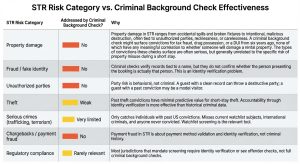
The pattern is clear. Criminal background checks were designed for long-term tenancy relationships where creditworthiness, employment stability, eviction history, and the ongoing proximity of a tenant to other residents over months or years all matter. In that context, understanding someone’s criminal history has a defensible purpose.
Short-term rentals are a fundamentally different model. Stays last 2–14 nights, on average. Guests book digitally, often across borders, sometimes last-minute. The risks are centered around identity fraud, property misuse, payment fraud, and behavioral issues like unauthorized parties, none of which are predicted or prevented by a criminal history report.
The core issue: Criminal background checks have minimal predictive value for the risks STR operators actually face. They answer a question that isn’t being asked.
When Are Background Checks Actually Required?
One of the most common reasons operators cite for running criminal background checks is compliance: “My insurance requires it,” or “The city requires it,” or “My HOA requires it.” It’s worth looking at whether those assumptions hold up.
Long-term stay regulations. Some jurisdictions treat stays of 30+ days as traditional rentals, which can trigger landlord-tenant laws and full tenant screening requirements. In these cases, criminal background checks may genuinely be required. But this applies to extended stays, not the typical short-term rental booking.
Municipal requirements. Very few municipalities specifically require criminal background checks for STR guests. Most jurisdictions that have implemented screening mandates require identity verification or sex offender registry checks, which are separate products. A good example is Payson, Arizona, where the ordinance requires a sex offender background check on each guest, not a full criminal history search. The distinction matters.
HOA covenants. Some HOAs include criminal background check requirements in their governing documents. However, legal experts increasingly advise caution here. New York City’s Fair Chance for Housing Act, which became effective in January 2025, restricts how criminal history can be used in housing decisions and imposes significant compliance requirements. While this law targets long-term housing, it reflects a broader legal trend that creates liability exposure for entities using criminal records to screen housing applicants without rigorous justification.
Beyond specific mandates, there are several misconceptions that drive unnecessary adoption of criminal background checks in STR.
“My insurance requires background checks.” Review your policy language carefully. Most policies use terms like “guest screening” or “due diligence,” not specifically “criminal background checks.” Identity verification combined with risk assessment typically satisfies these requirements.
“I need to check for sex offenders.” Sex offender registry checks are a separate product from criminal background checks. They’re included in watchlist screening solutions and don’t require a full criminal history search. Running FCRA criminal checks to find sex offenders is like using a sledgehammer when a scalpel is what’s needed.
“Airbnb does background checks, so I should too.” Airbnb’s own help center states that they “may” conduct background checks on US-based users and acknowledges significant limitations, including gaps in public records and periodic database updates. Their approach is not comprehensive, varies by location, and they explicitly state that background checks “don’t guarantee that a person won’t break the law in the future.”
“I need to know if someone has a criminal record.” This is worth pausing on. Ask why. What specific risk are you trying to prevent? In almost every case, the answer points back to identity verification, watchlist screening, or behavioral risk assessment, not criminal history.
The Real Question
None of this is to say that screening doesn’t matter. It matters enormously. The issue is that the industry has conflated “background check” with “FCRA criminal background check” without examining whether criminal history reports are actually relevant to short-term stays.
For hospitality tech platforms, this distinction is especially important. When operators, property owners, or inventory providers ask “do you support background checks?”, the platform has both an opportunity and a responsibility: understand what actually addresses the risk, educate users on the difference between perceived security and real security, and provide solutions that match the reality of how hospitality works.
For PMCs, the responsibility is similar. When a property owner or developer mandates background checks, the PMC is in the best position to understand whether that mandate is based on genuine regulatory requirements or assumptions that don’t hold up under scrutiny.
The question was never whether to screen guests. It’s whether the screening tool being used was ever designed for this job.
And if the answer is no, what does the right approach actually look like?
That’s exactly what we’ll cover in the next piece: a screening framework built for hospitality, combining identity verification, global watchlist screening, public records, adverse media analysis, and guest history databases, designed for the risks STR operators actually face, with faster results, lower costs, simpler compliance, and global coverage.
Because there is a better way to screen. It just doesn’t look like a traditional background check.
